
Every season of parenting looks different, and we get to learn to adapt to the four stages of parenting so that our relationship with our kids continues to thrive. Failure to adapt can lead to frustration for both the parent and the child.
Want another helpful parenting post on a similar topic? Read How to Avoid Controlling Your Teenager.

The Four Stages of Parenting
Confession: I’m not doing great adapting to my last role as a consultant. My 18-year-old is letting me know that (not in those exact words). As my kids have gotten older, I’ve been reminded of the four stages of parenting that my church has taught for years.
We come from a family-equipping church that wants to come alongside parents so they can be the first and best disciplers of their children. This approach has been a lifeline for me as I navigate being a mom to three very unique children.
I’ve been grateful for the teaching on how our parenting needs to adapt as our children move through different stages. Now that my kids have entered the last two stages, I find myself needing regular reminders of my role so that our relationships can continue to thrive.
What are the Four Stages of Parenting?
Hopefully, the graph above helps you grasp the four stages of parenting. I like to think of the angled line representing the amount of control we, as parents, have over our children.
Stage 1: Director (Age of Kids – Birth to 5)
In this stage, children are very reliant on their parents. We determine when they eat, sleep, what they do throughout the day, and where they go.
This is a phase where parents lovingly give a lot of direct instruction.
One of my mentors explained that sometimes she would gently take her child’s hand to help them obey—like picking up toys and putting them in the right spot—if they weren’t quick to follow instructions. We show them how to hold a crayon, do a puzzle, or play a game. We might use time-outs if behavior isn’t where it needs to be. Here’s one different way to handle a time-out when whining and crying are involved.
During this phase, clear boundaries are established within the family. Children are learning about safety, right from wrong, and how to generally function in life: using the potty, falling asleep, eating food, saying please and thank you, and cleaning up after themselves (a lifelong pursuit for some). Most of this stage involves very specific, direct instructions to follow.
The goal during this phase is to help it be a time of deep learning about the basics of what it means to be a human being, and it is mostly parent driven.
Stage 2: Trainer (Age of Kids 6-12)
The director phase begins to shift into the trainer phase around age six. The main difference is letting go a little and giving kids more independence, rather than commanding their every move. With each phase comes more self-reliance and autonomy.
In this stage, think of yourself as a trainer or teacher. You get to teach responsibility, character development, and work ethic. Kids start school, sports, and activities that give them a bit more freedom from your constant direction.
Keep learning fun, and begin to attach more of the why to the instructions.
They will have some chances to fail, but you will be there to quickly pick them up and teach them how to push through.
The goal during this phase is to build confidence and competence.
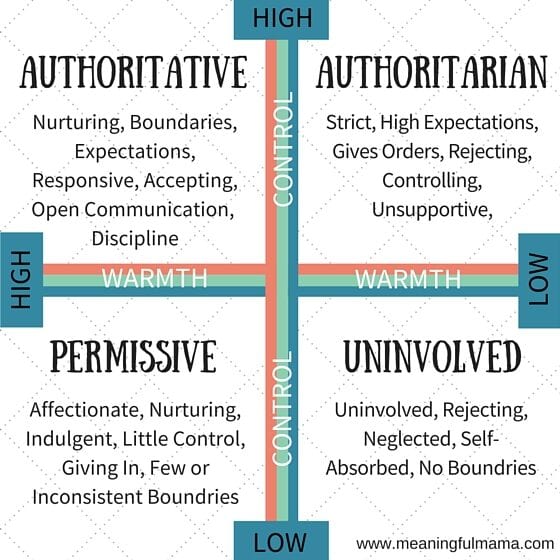
In all of these stages, it’s important to remember that our parenting should be both highly authoritative (clear instructions, guidelines, and boundaries) and highly loving (warmth, unconditional love, and safety). Here’s a chart to help (the upper left corner of the chart is where we want to reside as parents):
Stage 3: Coach and Cheerleader (Age of Kids – 13 to 18)
A good coach is knowledgeable, communicates well, and has high emotional intelligence. They lead with empathy, integrity, and adaptability while still establishing clear boundaries and helping kids set goals. Coaches empower through instruction, constructive feedback, and role modeling.
Coaches are also cheerleaders—pointing out what kids are doing well and celebrating victories along the way.
As our kids enter the teenage years, we get to embody this coaching mentality.
Once again, this stage involves giving up more control and allowing kids to develop autonomy, which can be terrifying. I get it. There’s a fine balance between maintaining rules and boundaries while also offering more freedom, allowing more failure, and resisting the urge to be overly critical or bossy (which I hate to admit can be my default). Reflecting on this tension was actually a catalyst for writing this reminder to myself.
Just remember: every time they fail, their brain grows.
Kids in this phase often show more rebellion, independent thinking, boundary-testing, and pulling at the reins. This is a normal part of development. Boundaries still matter, but kids need increasing freedom to make decisions, fail, and learn how to get back up. This can be incredibly challenging for parents.
The goal in this stage is to cultivate problem-solving skills, resilience, grit, and independence.
Stage 4: Consultant (Kids Age: 18+)
The 18–22 age range can be particularly blurry. Technically, they’re adults, but I call them pseudo-adults. They’re often living more independently for the first time and stepping toward full adulthood. While they may still rely on parents for certain things, they’re becoming largely self-reliant.
For kids who go to college, I’ve observed the tension when they come home. They’re used to independence (even though parents may still help with expenses, insurance, and support), but they return to a home with responsibilities, boundaries, and parents who are also learning how to transition into the consultant phase.
This stage requires a lot of letting go. We’re no longer calling the shots. Parents learn to wait patiently for adult children to come to them for advice, rather than inserting themselves where they’re not invited.
A helpful posture with adult kids is: “Let me know if I can help.” You become more of a supportive friend and mentor.
Lead with empathy and ask questions like, “Do you want help thinking this through, or do you just want me to listen?”
As kids get their own jobs and find spouses, our job is to be available and cultivate an environment where they want to join us for holidays, babysit the grandkids, or come over for dinner.
The goal of this phase is to become a person your child wants to come to with both their struggles and their successes because you aren’t overly controlling or critical.

The Risks of Being in the Wrong Stage
There are a couple of potential risks when parents stay in the wrong stage.
Risk 1: Failure to Launch
If I do too much for my kids, they risk failing to launch. When we enter rescue mode and try to fix all of their problems for them, we can unintentionally create soft kids. Of course, protection has its place, but strong kids are built by doing hard things.
If our teenagers aren’t making their own appointments, communicating with teachers, handling returns, or calling businesses, we may still be clinging to the director phase instead of transitioning into training and coaching.
Challenge is good. Even suffering can be good when framed correctly. It builds grit and develops life muscles needed to survive a world that is both beautiful and painful.
We need to let go so our kids can grow up—not to need us, but to want us.
Risk 2: Distancing
On the flip side, when parents remain too controlling, kids may rebel rather than rely. Failing to move into the next parenting stage can damage the relationship.
When parents are overly controlling, kids often pull away, shut down, or stop inviting parents into their lives—especially in adulthood.
When we can genuinely say, “I’m here if you need me,” kids are far more likely to step toward the relationship.

Christian Parenting
I believe the Bible is God’s Word and our best guide for life. In Ephesians 6, children are instructed to obey and honor their parents. Sometimes, as Christian parents, we stop there.
But we need to keep reading. Ephesians 6:4 says, “Fathers, do not provoke your children to anger, but bring them up in the discipline and instruction of the Lord.” How do we provoke our kids to anger? One way is by becoming authoritarian rather than authoritative—focusing on rules without prioritizing relationship. Another is staying in the first two stages of parenting too long, forgetting that as kids grow older, we must open our hands and trust the Lord to direct their lives.
Parenting isn’t easy. It grows us. Understanding our role during the different stages can be powerful as we adapt to our older children. It’s hard to let go.
I’m thankful for this reminder as I continue to be refined in my own relationships. I hope this has been helpful to you as well.
Want More Helpful Parenting Tips?
I haven’t always been the perfect parent, but I’m a student. I share with you as I learn and grow. It’s the heartbeat of Meaningful Mama.


I Lost Myself When I Became a Mom