I am excited to share with you this great science object lesson that teaches leadership to kids. Teaching through analogies and word pictures is an effective way to coach children.
Want more lessons on leadership? Check out this simple activity that equips kids to lead.
Science Object lesson that Teaches Leadership
Welcome to my character-building series. I will share more about this series at the end of this post, but first, I want to share with you today’s lesson that focuses on teaching leadership to kids.
Leadership is an important trait for kids to learn. Leadership comes in many forms, and I’m convinced that many different personalities can lead in their own style. The important thing is to help children learn how to lead others in a positive direction with a positive approach.
A good leader should be able to inspire, motivate, and energize a group. I want my kids to learn to have vision and passion and use their enthusiasm to inspire others toward an end goal or greater vision. This science object lesson is a great analogy to leadership.
Subject: Leadership
Objective: Kids will understand the qualities and effectiveness of good leadership.
Leadership Bible Verse: “Whoever wants to be first must be your servant – just as the Son of man did not come to be served, but to serve, and to give his life as a ransom for many.” – Matthew 20:27-28
Ask:
- What are some qualities you see in a good leader?
- Do you think anyone can become a leader?
- Why is leadership important?
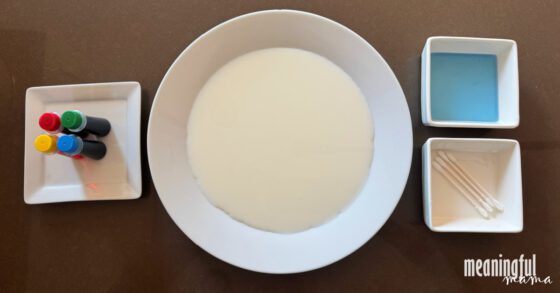
Materials Needed for this Lesson in Leadership
- White Ceramic Plate
- Liquid Food Coloring (gel does not work)
- Dawn Dish Soap (others might work, but I haven’t tried them)
- Q-Tips
- Room Temperature Milk
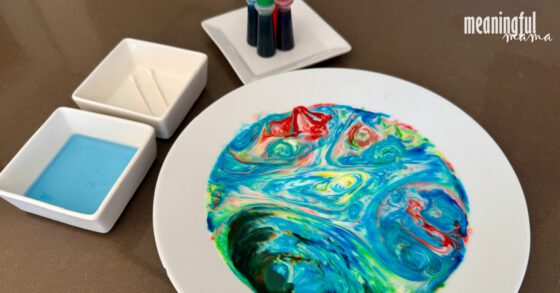
How to Do this Science Object Lesson that Teaches Leadership
This object lesson can be hands-on learning for kids, especially in a church or homeschool setting. In larger groups, the teacher may want to demonstrate it for kids to observe.
- Pour milk on the plate to just cover the bottom.
- Drop different colors of liquid food coloring in various places around the plate of milk. Do not stir or move the plate. You want the dots to stay in place.
- Say: “These drops of food coloring represent people. See how they all aren’t doing much right now. They are just sitting around, unmotivated.”
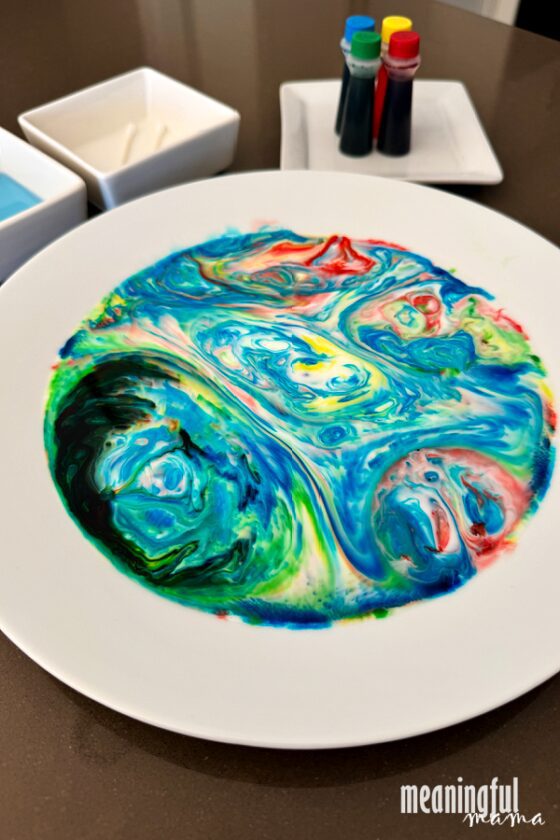
- Dip a Q-tip in dish soap and dip it into one place in the milk. Don’t swirl or move the Q-tip. Kids will probably gasp at what they see as the colors dance and swirl in the milk.
- Say: “The dish soap on the Q-tip represents a good leader who helps motivate a group.” Talk about some of the great traits of a good leader: a servant’s heart, a good communicator, a listener, enthusiasm, integrity, self-awareness, empathy, courage, and resilience. Expand on that or have kids discuss this as much as you want.
- Ask: “How did the ‘people’ (the colored dots) respond to ‘good leadership’ (the dish soap)?” (They became active and interactive, working together to get moving. You could also talk about how these dots of color represent how we are all many parts of one body with different talents. A strong leader comes along and motivates others in their specific strengths; magical things happen.
Teach the Science Behind this Experiment
What is happening? Milk has surface tension because it has a lot of water in it. The food coloring stays in one place because of that surface tension. When the soap is added, it breaks apart the bonds in the water molecules so that the color can start moving around in the milk.
Read more about the science here.
Video Tutorial for this Food Coloring and Dishsoap Science Experiment
Character Building Series
Welcome to my character building education series where we work on 52 traits throughout the year. 52 traits? Yes! That is one character building trait for every single week of the year.
More good news! Each trait comes with over a week’s worth of lessons. You could work on character with your kids every single day of the year if you chose to follow along.
This character-building activity focuses on leadership. Here is our initial lesson in leadership. If following the series, always do that lesson first. Click here for all of my lessons on leadership.
Please note: I am in the process of updating my series. I originally began this series in 2012, and it has great bones but needs a facelift.
Want more Lessons on Leadership?